
What ISO/IEC 17025 Accreditation Means for Calibration
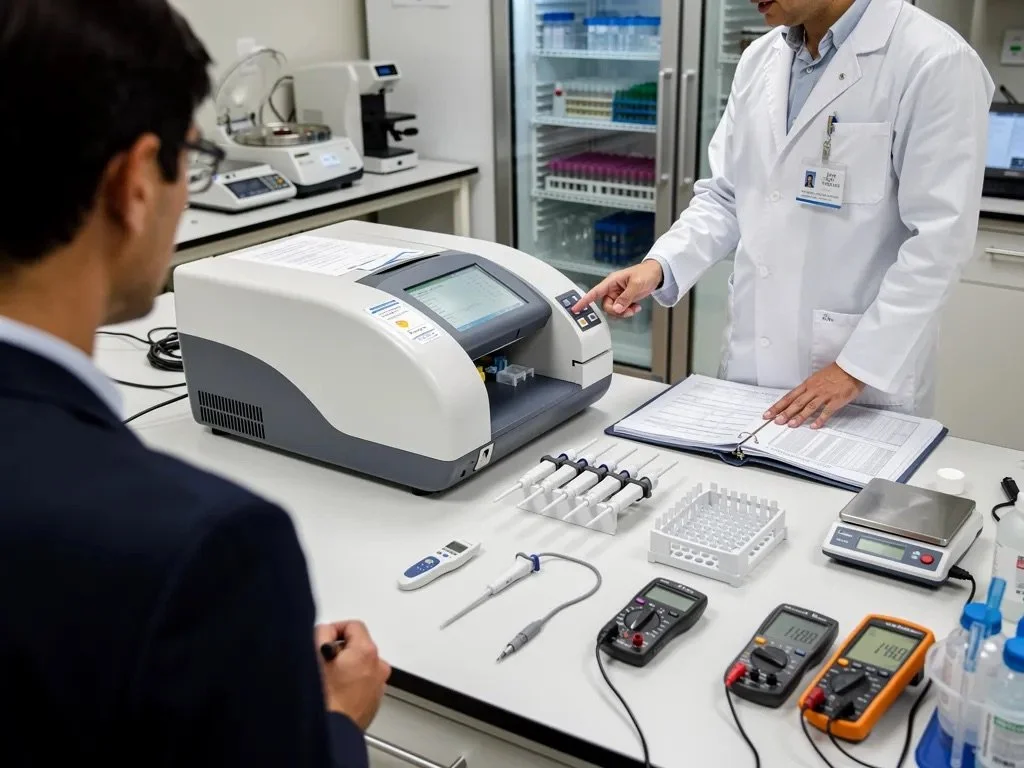
International Accreditation Laboratory Inspection
Ask ten vendors if they’re “NIST traceable” and nine of them will say yes without blinking. Traceability is a claim almost anyone can make. Accreditation is different — it’s a claim someone else has to verify.
ISO/IEC 17025 is the international standard that governs the competence of testing and calibration laboratories. It’s not a certificate you print after a self-assessment. It’s a third-party accreditation body — in the U.S., typically A2LA, ANAB, or PJLA — auditing a lab’s technical competence on a recurring cycle: its equipment, its uncertainty calculations, its technician training records, its environmental controls, and its traceability chain back to national standards.
That distinction matters more than most compliance officers realize until an auditor asks for it directly.
ISO/IEC 17025 vs. ISO 9001
ISO 9001 certifies that a company has a documented quality management system — procedures exist, records are kept, processes are repeatable. It says nothing about whether the lab is technically competent to calibrate a pressure gauge to the tolerance your process requires. A company can be ISO 9001 certified and still have no accredited capability to calibrate anything at all.
ISO/IEC 17025 certifies the technical work itself: the traceability, the measurement uncertainty, and the proficiency of the people doing the calibration. For a QA/QC manager sitting across from an FDA or FAA auditor, this is the difference that gets flagged in a finding. “Our vendor is ISO 9001 certified” answers a different question than the one being asked.
Why “NIST traceable” isn’t the same as accredited
NIST doesn’t certify calibration providers. NIST maintains the national measurement standards that a traceability chain has to link back to. Any lab can print “NIST traceable” on a sticker. What accreditation adds is a documented, unbroken chain of comparisons — instrument to reference standard to national standard — with the uncertainty at each link known and reported. Without that chain being verified by an accreditation body, “NIST traceable” is a claim, not a proof.
Key takeaways
ISO/IEC 17025 accreditation verifies a lab’s technical competence — its equipment, uncertainty calculations, technician training, and traceability chain — through recurring third-party audits, unlike a self-issued “NIST traceable” claim.
ISO 9001 certifies that a quality management system exists; ISO/IEC 17025 certifies that the technical calibration work itself is competent. The two answer different audit questions.
A valid ISO/IEC 17025 certificate should show as-found/as-left data, measurement uncertainty, the traceability path to national standards, environmental conditions, and an accreditation number tied to a specific scope.
Accreditation is scoped to specific parameters and measurement ranges (the Calibration and Measurement Capability, or CMC). A provider accredited for one type of calibration may not be accredited for another.
Checking a provider’s published Scope of Accreditation takes minutes and is the fastest way to catch a compliance gap before an auditor does.
In CLIA, GMP, and AS9100 environments alike, accredited and fully documented calibration is what limits an audit finding instead of widening it.
The 3 technical pillars every compliance officer should audit
If you’re evaluating a calibration provider — or defending your current one during an audit — these are the three things worth actually checking, not just asking about.
Metrological traceability. Every measurement your provider reports should trace back through an unbroken chain of calibrations to the SI unit it’s measuring, with no gaps. Ask for the chain, not just the claim.
Measurement uncertainty budgeting. Every calibration result should come with a stated uncertainty — the margin of error around the reported value. For high-stakes testing (drug stability chambers, surgical instrument calibration, aerospace tolerance stack-ups), a result without an uncertainty figure is incomplete. It’s the number that tells you whether your equipment is actually within tolerance or just close to the line.
Technician proficiency and environmental controls. Calibration isn’t just running a procedure — it’s controlling the variables around it. Temperature, humidity, vibration, and technician training all affect the result. Accredited labs document these controls; that documentation is part of what an auditor is trained to look for.
Decision mechanics: reading calibration certificates and Scopes of Accreditation
You don’t want to skip this step and it’s the part an auditor won’t.
The artifact test — what a valid ISO/IEC 17025 calibration certificate should include:
As-found and as-left data (the readings before and after any adjustment)
Measurement uncertainty for each reported value
The traceability path to national/SI standards
Environmental conditions at the time of calibration
The accreditation body’s logo or accreditation number, tied to a specific scope
Identification of the equipment used to perform the calibration, itself traceable
If a certificate is missing uncertainty figures or as-found data, it is not a full ISO/IEC 17025 certificate — even if the word “accredited” appears somewhere on the page. (What documentation looks like in practice.)
Scope of Accreditation verification. Accreditation isn’t blanket. It’s scoped — to specific parameters, specific measurement ranges, and a specific Calibration and Measurement Capability (CMC) for each. A lab can be accredited for temperature calibration and not for pressure. A provider can be accredited and still be performing a specific calibration outside their scope, which means that specific certificate isn’t actually backed by accreditation. Every accreditation body publishes the current Scope of Accreditation online. It takes two minutes to check, and it’s the single fastest way to catch a gap before an auditor does.
Industry translation: what ISO/IEC 17025 means across regulated sectors
The standard is the same. What it protects you from isn’t.
Healthcare & clinical diagnostics (CLIA / CAP). An out-of-tolerance pipette or temperature probe doesn’t just fail a calibration check — it puts every patient result run on that equipment in question. CLIA and CAP inspections can arrive unannounced, and calibration records are one of the first things reviewed. Accredited calibration with full documentation is what lets a lab director answer an inspector’s question in the room, instead of scrambling to reconstruct a chain of custody afterward.
Pharma & biotech (GMP / FDA 21 CFR). Here, calibration is a data integrity issue as much as a technical one. An out-of-tolerance (OOT) finding on a chamber or balance can trigger a root-cause investigation that reaches back through every batch run on that equipment since its last calibration. Accredited documentation — with uncertainty figures and as-found data intact — is what limits that investigation instead of widening it.
Aerospace & high-precision manufacturing (AS9100). Tolerance stack-up is unforgiving. A go/no-go gauge or dimensional instrument that’s out of calibration by a fraction most industries wouldn’t notice can produce a part that fails downstream, or a defect that travels through the supply chain before anyone catches it. AS9100 audits scrutinize calibration records specifically because the cost of a miss compounds.
Three different industries, three different failure modes — but the same underlying requirement: a documented, verifiable, in-scope accreditation behind every certificate.
Partnering with the right provider: audit protection and operational continuity
Accreditation answers the technical question. The rest is operational.
Onsite vs. mail-in. Onsite calibration keeps equipment in service and cuts downtime — critical for labs that can’t afford a piece of equipment to be gone for days. Mail-in works for equipment that can be spared or that needs decontamination or specialized bench work first. The right provider should be able to tell you honestly which model fits which piece of equipment, not push one model because it’s easier for them. (How Joint Matters structures service levels.)
Cost of failure vs. cost of service. The cheapest calibration quote isn’t the cheapest option if the certificate doesn’t hold up under audit, or if an out-of-scope calibration has to be redone. The real comparison is between the provider’s fee and what an audit finding, a recall, or a defective part actually costs — in dollars, in time, and in the inspection that follows.
A provider that will show you their Scope of Accreditation without being asked twice, that reports uncertainty on every certificate, and that will tell you plainly when something is outside their capability and point you to someone who can handle it — that’s the actual signal of competence. Not the badge on the website. The documentation behind it.
If you want to verify what’s covered before you need it in an audit, request Joint Matters’ current Scope of Accreditation and a sample certificate — or start from our FAQs on accreditation and documentation.
FAQ
What’s the difference between ISO/IEC 17025 and ISO 9001?
ISO 9001 confirms a quality management system exists. ISO/IEC 17025 confirms the laboratory is technically competent for the calibrations in its scope.
Is “NIST traceable” the same as accredited?
No. NIST maintains national standards; it does not certify your calibration vendor. Accreditation is third-party verification of the traceability chain and uncertainty.
What should be on an ISO/IEC 17025 calibration certificate?
At minimum: as-found/as-left data, measurement uncertainty, traceability path, environmental conditions, and an accreditation number tied to a published scope.
How do I check a lab’s Scope of Accreditation?
Look up the lab’s accreditation number on the accreditation body’s public directory (A2LA, ANAB, PJLA, and similar). Confirm the parameter and range you need are listed under their CMC.
Does accreditation cover every instrument a lab will touch?
No. Accreditation is scoped. Always match the work you need to the published scope before you schedule.